



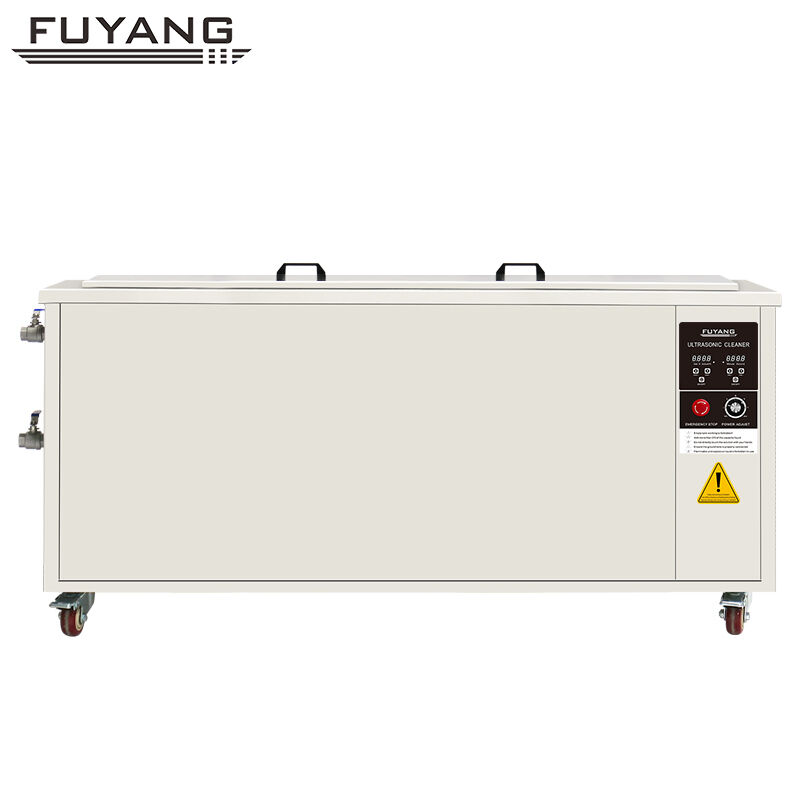

Stainless Steel 1500L 40KHz Industrial Injector Ultrasonic Cleaner Single Tank Casters
| Model name | F-360W |
| Internal tank size | 1000*400*400mm |
| Application | Clean Spray Flannel Mold |
| Function | Removing dirts, oil, rust, grease |
| Feature | No damage to precision mold |
| Tank capacity | 160L |
| Ultrasonic power | 1800W |
| Heating power | 4500W |
| Time control | 0~99 minutes |
| Temperature control | 20~95℃ |
| Water inlet / outlet | Yes |
| Voltage | 380V |
Support and Services:
Technical Support and Service for Industrial Ultrasonic Cleaner
At ABC Company, we offer our customers comprehensive technical support and service for industrial ultrasonic cleaners. Our experienced technicians are available to answer any questions you may have about your product. We also provide repair services for any issue that may arise with your industrial ultrasonic cleaner. Our team of experts can help you troubleshoot and diagnose any problems you may have and provide you with the necessary repairs. Additionally, we provide preventive maintenance services to ensure your industrial ultrasonic cleaner is running optimally.
The higher the frequency, the higher the cavitation threshold, which means that to produce acoustic cavitation, the higher the frequency, the greater the sound intensity required. For example, to produce cavitation in water, the power required at 400kHz is 10 times greater than that at 10kHz. The frequency range generally used is 20-40kHz. The low frequency has high cavitation strength, which is suitable for the occasions where the surface of large cleaning parts and the surface of the cleaning parts have high bonding strength, but it is not easy to penetrate deep holes and parts with complex surface shapes, and the noise is large; higher frequencies have higher cavitation strength Weak, but low noise, suitable for cleaning with more complex surface shapes, slits and dirt and the surface of the cleaning part. Sound field distribution. A stable reverberation field is beneficial to cleaning. If there is a standing wave sound field in the cleaning tank, the cleaning parts cannot be cleaned uniformly due to uneven sound pressure distribution. Therefore, when possible, the geometry of the groove should be chosen to be suitable for establishing a mixed sound field. In addition, dual-frequency, multi-frequency, and frequency sweeping modes can be used to avoid cleaning the "dead zone".
- What is Ultrasonic Cleaning
In a process termed "cavitation", micron-size bubbles form and grow due to alternating positive and negative pressure waves in a solution. The bubbles subjected to these alternating pressure waves continue to grow until they reach resonant size. Just prior to the bubble implosion, there is a tremendous amount of energy stored inside the bubble itself. Temperature inside a cavitating bubble can be extremely high, with pressures up to 500 atm. The implosion event, when it occurs near a hard surface, changes the bubble into a suction jet about one-tenth the bubble size, which travels at speeds up to 400 km/hr away from the hard surface. With the combination of pressure, temperature, and velocity, the jet frees contaminants from their bonds with the substrate. Because of the inherently small size of the jet and the relatively large energy, ultrasonic cleaning has the ability to reach into small crevices and remove entrapped soils very effectively